Your Website Isn’t About You

Your Website Isn't About You

It’s your website, sure.

But here’s the funny thing…

It isn’t really about you.

It’s about the person visiting it.

Weird, right?

When someone lands on your website, they aren’t thinking about your business the way you are.

In fact, they only care about your business for one reason:

Can you solve their problem?

Company history? Secondary.

The tools and equipment you use? Secondary.

Where you went to school? Secondary.

The primary question they’re trying to answer is:

Can this business solve the problem I’m having right now?

Your website needs to answer that question as quickly as possible.

The easier you make it, the more likely they are to become a customer.

Now, does this mean the secondary things don’t matter?

Not at all.

They do.

People like doing business with people.

Your story builds trust. Your experience builds credibility.

But those things should support the visitor’s journey—not get in the way of it.

A surprising number of websites are built from the owner’s point of view instead of the customer’s.

They spend paragraphs talking about themselves before they’ve clearly explained what they actually do. They use industry jargon that visitors don’t understand. They bury their contact information—or make it difficult to get in touch. They leave visitors wondering what to do next.

Instead, try looking at your website through a visitor’s eyes.

Ask yourself:

  • Is it immediately clear what I do?
  • Is it obvious who I help?
  • Can someone contact me in seconds?
  • Does each page naturally lead to the next step?

Your website isn’t a trophy. It isn’t there to impress you.

It’s there to help someone become your next customer.

If your website makes that easy, it’s doing its job.

Is Your Website an Asset…or a Liability?

Is Your Website an Asset...or a Liability?

Imagine hiring an employee who never answered the phone. Who confused customers. Who made people wait. Who never asked for the business. Who made your business look outdated and stuck in the past.

You’d fire them.

Yet many businesses have a website that does exactly that.

Your website isn’t just a collection of words, images, and videos.

It’s a business tool.

It’s often the first impression someone has of your business. In many cases, it’s working long before you ever speak to a customer.

The question is:

Is it helping your business…or quietly costing you customers?

A Website Should Build Trust

Impressions happen quickly.

You’ve probably heard that when you meet someone new, they form an impression of you in seconds.

The same is true of your website.

Within a few seconds, visitors are asking themselves questions like:

  • Who are they?
  • Can they solve my problem?
  • Do I like them?
  • Can I trust them?
  • How do I contact them?

If your website doesn’t answer those questions quickly, visitors often move on. And with no shortage of competitors out there, they may never come back.

And yes, this is true even if your business is rock solid. Even if you’ve been in business for 20 years. Even if you have lots of satisfied customers.

Online, your business is only as good as your website communicates it is.

Small Problems Add Up

A slow website.

A confusing menu.

Tiny text on a phone.

Outdated, cheesy photos.

Broken links.

No clear way to contact you.

Each one might seem minor on its own.

Together, they create friction.

And friction costs you customers.

Think of two stores.

Store A makes everything easy. You walk in, it’s clean and bright. The aisles are organized and everything is easy to find. Staff members greet you and ask if you need help. When you’re ready to check out, someone is there to help you right away.

Store B makes everything harder. It’s dirty. Some of the lights don’t work. The layout is confusing. You can’t find anyone to help you, and the few employees you do see are standing around on their phones. Checking out is a frustrating experience.

All else equal, which store would you rather shop at?

Exactly.

Your customers feel the same way about websites.

Your Website Should Make Doing Business Easy

I said this before, and I’ll say it again.

The best websites aren’t complicated.

They’re clear.

Visitors should know:

  • What you do.
  • Who you help.
  • Why they should choose you.
  • What to do next.

That’s it.

When people don’t have to think, they’re far more likely to take action.

And that’s what you want…action.

Your Website Is an Investment

A good website isn’t an expense.

It’s a tool that works around the clock.

It builds trust. Answers questions. Generates leads. And helps turn visitors into customers.

Done well, it pays for itself.

Your website should be one of your hardest-working employees.

If your website were an employee…would you promote it or fire it?

Make sure it’s working for you—not against you.

They Should Know in Five Seconds

They Should Know in Five Seconds

Imagine someone lands on your website.

Five seconds later…

Can they answer these three questions?

  • Can you solve my problem?
  • Why should I choose you?
  • What should I do next?

If they can’t, you’ve probably lost them.

It doesn’t matter how beautiful your website is if visitors have to play detective.

One thing I’ve noticed while looking through local business websites is that many of them assume visitors already know and trust them.

They don’t.

Instead, the homepage jumps straight into clever headlines, flashy animations, or industry jargon without first answering the most basic questions.

Your homepage isn’t trying to win a design award.

It’s trying to start a conversation.

Clear beats clever.

Every time.

Play Visitor

Visit your own website as if you’ve never seen it before.

Without clicking anything, can you answer those 3 questions in five seconds?

If not, imagine how a first-time visitor feels.

Probably confused.

Probably gone.

Easy Does It

Don’t challenge potential customers to play Sherlock Holmes.

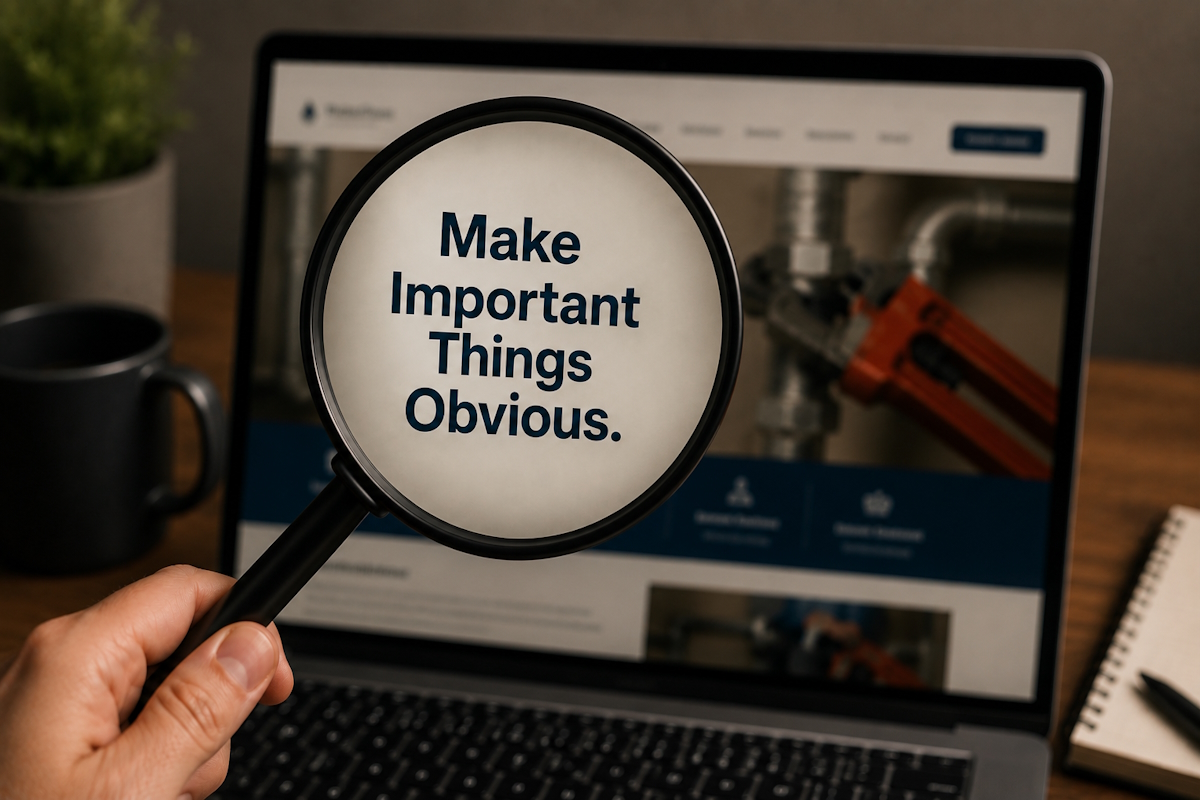
Make the important things obvious.

Use the five-second rule.

Your Website Should Make It Easy to Do Business With You

Your Website Should Make It Easy to Do Business With You

Your website isn’t there to look pretty.

It’s not there to win awards.

It’s not there just to be there.

No, when you boil it down, your website really has one job:

To make it easy to do business with you.

That’s it.

Some websites do this excellently.

They immediately tell visitors what they do, who they serve, and how to get in touch (or whatever other action you want them to take).

Some do it very poorly.

Ask yourself one question:

If someone wanted to hire me today, is it easy?

Or do they need to jump through hoops? Do they need to play detective to find my email or phone number? Does my website even work?

Here’s Exactly What the Visitor Should See

What you do. They should immediately know that they’re in the right place.

Contact info. They should be able to contact you at any time.

A request for service or a quote (if applicable). They should be able to request the work right there on the website.

Reasons to trust you. Photos of you and your work, testimonials (if you have them), blog posts showing your expertise, and anything else that helps visitors feel confident they’re hiring the right person.

Anything else? Window dressing.

Make It Easy

Look, a website doesn’t have to win design awards.

It doesn’t have to be flashy.

It just has to remove obstacles between someone saying:

“I think this is the right company.”

and

“Yeah, they can do the job.”

And whether it’s a complete overhaul, or small improvements, remember:

Your website should make it easy to do business with you.

Keep that front of mind.